
July 31st, 2025
125. Gerasa/Gadara/Gergesa (Kursi)
There seems to be a lot of confusion in translations about identifying the site where Jesus healed the demon-possessed man and sent the demons into the pigs. Why is that?
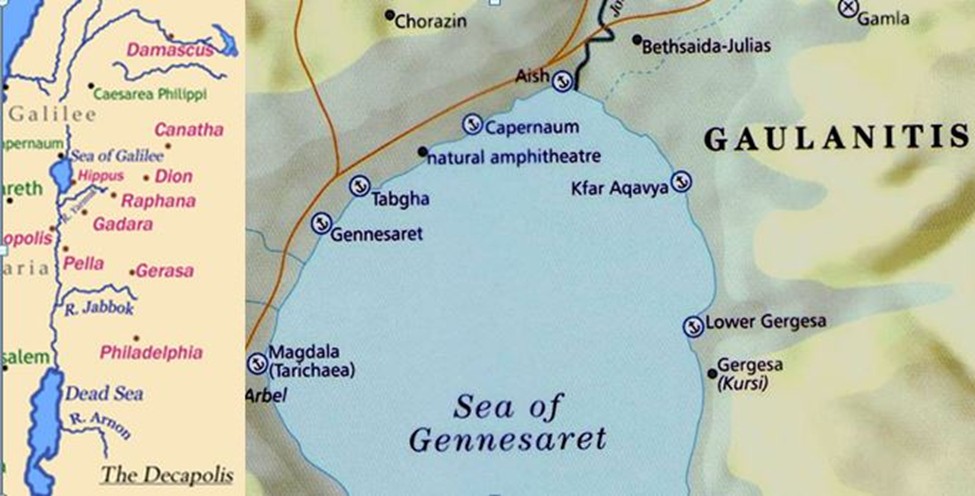
The problem with identifying the site where Jesus healed the demon-possessed man and where the pigs rushed down a steep bank and drowned in the sea is that the Gospel accounts (Mt 8:28, Mk 5:1, and Lk 8:26) suggest three different names for the place: Gerasa, Gadara, and Gergesa.1
The prominent city of Gerasa (Jerash) is more than 30 miles from the sea. This fact alone seems to rule it out as the site of the miracle. The appearance of this name in the Greek text appears to be the result of the fact that this place may have been very familiar to the copyists, whereas the others were not.
The city of Gadara is 5 or 6 miles from the sea, but its territory may touch the sea on the southeast corner. The site of the city itself does not fit the geographical description of the site of the miracle in the Gospels. It is not located on steep cliffs on the shore of the sea.
Although there is significant textual support for these two readings, the geography of the text suggests that the correct reading is the third site, Gergesa. This site is located near Hippos on the east shore of the sea, near the likely site of the Feeding of the 5000. The site today is called Kursi. The ruins of a Byzantine monastery and church there have been connected with the Miracle of the Swine. Byzantine pilgrims visited the site and its environs as the place of the healing of the demon-possessed man.
The regular rule of the EHV is that in choosing a variant, we favor the reading which has early, widespread textual support, rather than relying on subjective evaluation of the likelihood of the various readings. In this case, however, this rule does not work very well since the entire textual tradition is early and widespread. All three possibilities are already discussed by the 3rd century church father Origen, who rejects Gerasa and Gadara for the reasons cited above and opts for Gergesa.
One who aims at fuller understanding of the holy Scriptures must not neglect the careful examination of the proper names in it. Concerning Palestinian place names the Greek copies are often incorrect, and one might be misled by them. The displacement of the swine, who were driven down a steep place by the demons and drowned in the sea, is said to have taken place in the country of the Gerasenes. Now, Gerasa is a town of Arabia, but has no sea or lake near it. The Evangelists would not have made a statement so obviously and demonstrably false; for they were men who informed themselves carefully of all matters connected with Judea. But in a few copies we have found, “into the country of the Gadarenes.” On this reading, Gadara is described as a town of Judea. In its neighborhood are the well-known hot springs. There is no lake there with overhanging banks, nor any sea. But Gergesa, from which the name Gergesenes is taken, is an old town in the neighborhood of the lake now called Tiberias. On the edge of it there is a steep place bordering on the lake, from which the pigs could have been driven down by the demons. Commentary on John 6.24.
Eusebius in his Onomasticon also refers to the three sites we know as Gergesa, Gerasa, and Gadara:2
Gergasei (Gergasi) (No. 304) Located on the Jordan near the city of the Galaad (or, a city of Transjordan near tribe Mt.Galaad) which the tribe of Manasse received. It is said to be Gerash the famous city of Arabia. Some affirm it to be Gadara. But the Gospel mentions the Gerassenes (Gergessenes).
Gergesa (No. 363) Where the Lord healed the demoniacs. Today a village is pointed out on the mountains near Lake Tiberias where the swine were cast down to death. “There the Lord healed the demoniacs. Now a village is pointed out beside Lake Tiberias, into which the swine rushed down headlong (Onomasticon 74:13).
In spite of a certain amount of confusion on Eusebius’s part and differences in various translations of his work, it is clear that both Eusebius and Origen were aware of the three sites and chose Gergesa as the correct one.
This may be one of the rare cases when studying the wider context of the text deserves precedence over simply weighing the manuscript evidence.
1 There are variant spellings of all of these place names in the Greek, Latin, and English sources, which adds to the difficulty of keeping things straight.
2 Again note the spelling confusion in the use of the names.