December 30th, 2025
124. Which is more certain, Scripture or our experience?
In 2 Peter 1:19, translations and commentaries seem to give opposite interpretations. One option seems to say that the prophetic word that testified to Jesus’ deity was more certain than Peter’s experience on the Mount of Transfiguration. Other translations suggest that the testimony of Scripture was made more convincing by the vision Peter saw on the mountain. Which is preferable?
Two witnesses are referred to in 2 Peter 1:16-19.
We Have God's Inspired Word16To be sure, we were not following cunningly devised fables when we made known to you the powerful appearance of our Lord Jesus Christ, but we were eyewitnesses of his majesty. 17For he received honor and glory from God the Father, when the voice came to him from within the Majestic Glory, saying, “This is my Son, whom I love; with him I am well pleased.”[] 18We heard this voice, which came out of heaven when we were with him on the holy mountain.19We also have the completely reliable prophetic word. You do well to pay attention to it, as to a lamp shining in a dark place, until the day dawns and the Morning Star rises in your hearts,
The key line is the beginning of verse 19: We also have the completely reliable prophetic word. Let us look at this line in several translations.
NLT | Because of that experience, we have even greater confidence in the message proclaimed by the prophets. |
NCV | This makes us more sure about the message the prophets gave. |
ESV | And we have the prophetic word more fully confirmed. |
ASV | And we have the word of prophecy made more sure. |
DARBY | And we have the prophetic word made surer. |
NKJV | And so we have the prophetic word confirmed. |
GW | So we regard the words of the prophets as confirmed beyond all doubt. |
HCSB | So we have the prophetic word strongly confirmed. |
NRSV | So we have the prophetic message more fully confirmed. |
NIrV | The word of the prophets is made more certain. |
NASB95 | So we have the prophetic word made more sure. |
To a greater or lesser degree, all the preceding translations point to the vision as strengthening the testimony of Scripture. The following translations, however, point to Scripture as the strongest witness.
LEB | And we possess as more reliable the prophetic word. (The Lexham English Bible) |
KJV | We have also a more sure word of prophecy. |
EHV | We also have the completely reliable prophetic word. |
The EHV places this section under the heading: We Have God’s Inspired Word. The section concludes with the verse: “In fact, no prophecy ever came by the will of man, but men spoke from God as they were being carried along by the Holy Spirit.” This sees Scripture as the primary focus of the section.
Does the grammar of the verse lean toward one emphasis or the other?
καὶ ἔχομεν βεβαιότερον τὸν προφητικὸν λόγον
and we have more sure the prophetic word.
and we have [as] more sure the prophetic word.
The grammatical discussion seems to result in a one-to-one tie. βεβαιότερον (bebaioteron) is in fact a comparative form, more sure. But some grammarians assert that βεβαιότερον does not have a true comparative meaning here, but a so-called elative meaning, very sure. Such a weakened use of the comparative force of the form does seem to occur in New Testament Greek. Putting it another way, the comparative form can be ambiguous in New Testament Greek. (For a more detailed discussion of this grammatical issue see FAQ 67 on the Wartburg Project website.)
So where does this leave the preacher? A pastor preaching on this text will undoubtedly have to preach on both the powerful testimony of the Transfiguration and the more powerful testimony of Scripture to Jesus’ deity. Experience can deceive us. Scripture cannot. There can be false visions. There cannot be false Scripture. If the EHV section heading is correct, the greater emphasis of the pericope will be on Scripture, unless perhaps this text is being used on Transfiguration Sunday.
In preaching on an exegetical question (an exegetical question is when there are two possible interpretations of a text, either of which can be correct) the preacher will almost always refer to both.
The key emphasis of the text is caught by the hymn, We Have a Sure Prophetic Word, which is an echo of the King James rendering.
We have a sure prophetic Word
By inspiration of the Lord.
And though assailed on ev'ry hand,
Jehovah's Word shall ever stand.Abiding, steadfast, firm, and sure,
The teachings of the Word endure.
Blest he who trusts this steadfast Word.
His anchor holds in Christ, the Lord.
Another exegetical question which compares the value of our experience with the value of God’s testimony in found in 1 John 3:19-21.
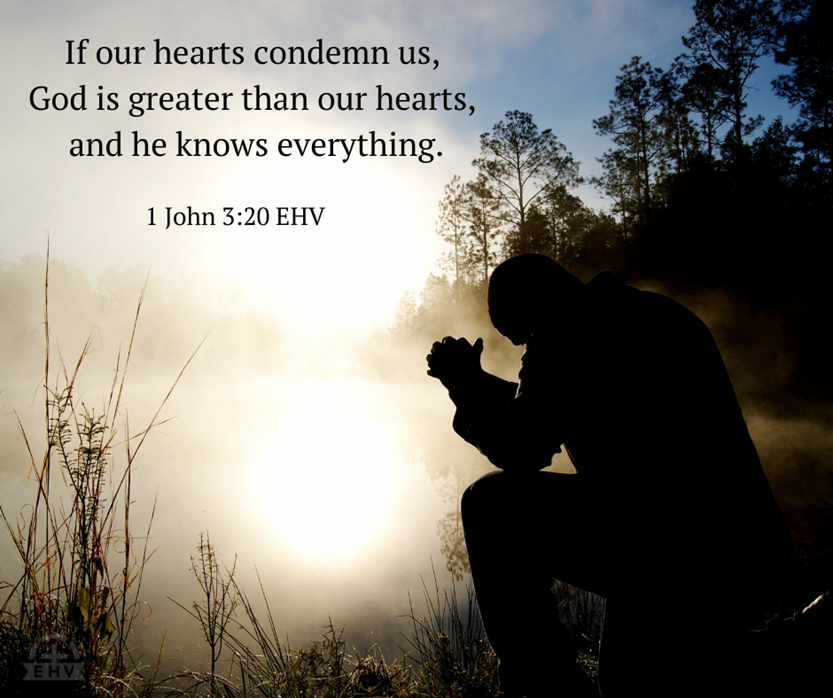
19This is how we know that we are of the truth and how we will set our hearts at rest in his presence: 20If our hearts condemn us, God is greater than our hearts, and he knows everything. 21Dear friends, if our hearts do not condemn us, we have confidence before God.
Where do we look for our ultimate assurance—in our life or in God’s verdict?
1 John 3:18 describes the circumstances that govern verses 19-20: “Little children, we must not love with word or speech, but with truth and action.”
Verses 19 and 20 then identify our strongest source of comfort.
NIV | This then is how we know that we belong to the truth, and how we set our hearts at rest in his presence 20whenever our hearts condemn us. For God is greater than our hearts, and he knows everything. |
EHV | This is how we know that we are of the truth and how we will set our hearts at rest in his presence: 20If our hearts condemn us, God is greater than our hearts, and he knows everything. |
The grammatical question is whether there is a strong stop at the end of verse 19. Many translations connect our assurance in verse 20 with the preceding description of works in verse 18 and 19. The translations of the KJV tradition and the EHV, connect our assurance more strongly with God’s verdict, not with our feeling about our works.
We are well aware of our sins, and so our hearts (consciences) often condemn us. But God knows everything. Of course, he knows all of our sins, but he also knows that Jesus paid for all of our sins when he died on the cross. He has declared us forgiven, and this remains true even in low moments when we don’t feel it. Based on the gospel promises of God in Holy Scripture, a believer can say, “I cling to what my Savior taught and trust it, whether felt or not. I know I am forgiven through Christ Jesus, my Savior!” Our greatest comfort is outside of us, in our gracious God and his gospel promises.